
If someone would have told CNCC how bright the future of paleontology would be when a former instructor came across a dinosaur bone in the Colorado desert with their Great Dane, Walter, no one would have believed them. Back in 2014, finding this dinosaur (named Walter after the dog), would prove to be a catalyst for CNCC’s paleontology program. CNCC had a few options: hand the dig over to another institution to manage, run the site but then relinquish the specimen for housing at an existing approved repository, or run the dig site and keep Walter on campus by meeting the requirements to become a federally-approved repository. Only the third option would provide ongoing learning opportunities for CNCC students. CNCC opted to make the building upgrades and meet other various standards that would allow Walter to remain on campus , creating the first community college approved repository in the United States.
This find would set CNCC on a path to develop its uniquely hands-on, experiential paleontology course of studies, which officially launched in fall, 2019. The program provides 100- and 200-level students with the field, lab, and exhibit experience that many advanced students don’t get until grad school. Today, the CNCC program extends to the community — offering one-of-a-kind learning opportunities for the public. And, as a result of the find, the college houses a federally-operated artifact repository called the Colorado Northwestern Field Museum. Students can benefit from the affordable community college tuition while taking paleontology courses as part of an Associates degree at the college. That gives students a considerable head start if they choose to later transfer to a four-year institution to continue their studies in the field or apply the skills they learn to a variety of jobs when they graduate from CNCC.
With such a breadth of subject matter and skill development, CNCC’s paleontology studies can open the door to many career options. Whether your goal is going straight to work, transferring to a university for a bachelor’s in just about any science-related discipline, or pursuing a master’s or doctorate in the field, CNCC’s paleontology courses can lay the appropriate foundation for your next steps.
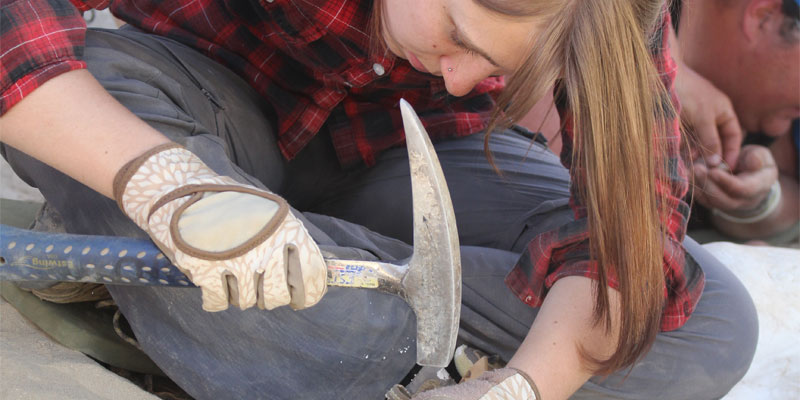
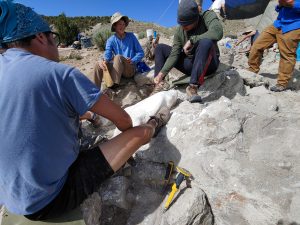
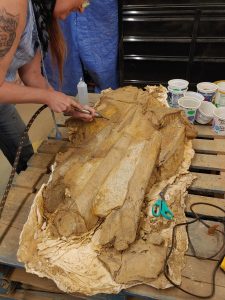 Many careers within the paleontology field, such as research and teaching, require an advanced degree. Because of the unusually comprehensive and hands-on opportunities offered in the paleontology. Although CNCC is a two-year institution where students can take their chemistry, biology, and all those basics, there is also the added benefit to providing a hands-on field paleontology component that students wouldn’t normally get until they are at a master’s or Ph.D. level. A twofold approach where students can come out and dig for two weeks and are taught all they need to know, from geology and mapping to techniques used out in the field. Then they come back and prepare the bones in the labs, and they get to see behind-the-scenes museum protocols, procedures, and data tracking.
Though paleontologists do much more than uncover buried treasures at dinosaur dig sites, dinosaur bones are not an unusual sight for scientists and students who dig in Colorado. Both CNCC campuses sit on a hotbed — or rather, more like a lakebed — of bones waiting to help scientists tell the Earth’s story. In Colorado, much of that story comes from the chapter of Earth’s history known as the Cretaceous Period. During that time, much of the area was covered by a shallow sea fed by multiple rivers and teeming with life.
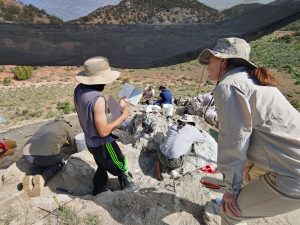 The rivers dumped sediment into the river deltas, burying carcasses that were preserved through many millennia, while the inland sea dried up and Colorado was pushed more than a mile up in elevation. NW Colorado has areas that are just littered with bones, whether it’s dinosaur or mammal or turtle or crocodile. CNCC often gets calls from the public and from the Bureau of Land Management (BLM) who are understaffed, asking, ‘There’s a report of a dinosaur bone in the middle of the road, can you go check it out?’
Even though Walter and the animals with whom he shared the land and sea died out, the descendants of the dinosaurs who once ruled the air managed to weather the asteroid aftermath and are still with us. Bird’s today are a direct descendant of dinosaurs, and to imagine how the evolution of that occurred is experienced in the field.
While we don’t know exactly what Walter experienced 70 million years ago, today he is a storyteller; his bones are helping CNCC staff and students piece together and understand the history of the planet and the land we live on.
Members of the community around Craig, as well as anyone who wants to take a two-week trip to Craig, can enroll either for credit or not-for-credit in the two-week digs during the summer. The sessions include Community Days, where CNCC students are tasked with teaching science to the public, using exhibits they have designed themselves. By teaching others, students demonstrate their mastery of the subject matter and communication skills.